
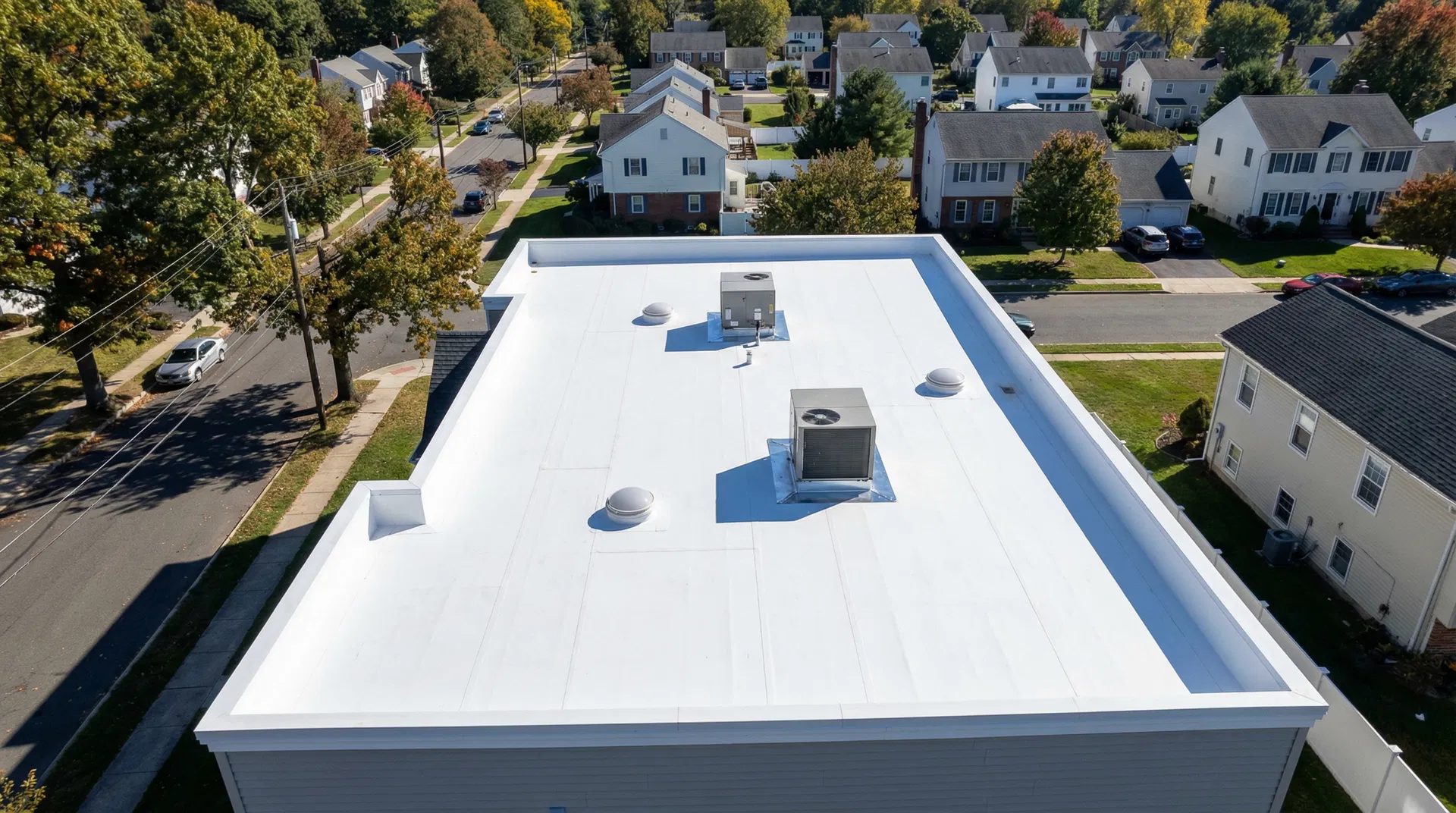
1. What Is a Flat Roof? Understanding Low-Slope Roofing Systems
A flat roof — more accurately described as a low-slope roof — is any roofing system with a pitch of less than 3:12 (three inches of rise for every twelve inches of horizontal run). Unlike steep-slope roofs that shed water through gravity alone, flat roofs rely on a combination of slight drainage slope, internal drains, and a continuous waterproof membrane to manage precipitation. This fundamental difference in water management makes flat roofing a specialized discipline that requires different materials, installation techniques, and maintenance practices than conventional shingle roofing.
In residential applications throughout Phillipsburg and Warren County, flat roofs most commonly appear on rear additions and sunrooms, detached and attached garages, enclosed porches and carports, and full flat-roof structures on mid-century modern homes. Each of these applications presents unique challenges — from drainage design and insulation requirements to flashing details around penetrations and parapet walls.
2. Why Phillipsburg, NJ Homes Have Flat Roofs
Phillipsburg's residential housing stock reflects the town's history as a working-class industrial community that grew rapidly during the late 19th and early 20th centuries. The town's older neighborhoods — particularly those built between the 1920s and 1960s — feature a high concentration of homes with flat-roofed rear additions, detached garages, and enclosed porches. These structures were built during an era when flat roofing was the economical choice for secondary structures, and built-up roofing (BUR) systems using layers of felt and hot tar were the standard installation method.
Today, many of these original BUR systems have been replaced once or twice — often with EPDM rubber membranes installed in the 1990s and 2000s. Those second-generation systems are now reaching the end of their 20–25 year lifespan, creating a significant wave of flat roof replacement demand across Phillipsburg and the surrounding Warren County communities of Lopatcong Township, Alpha, and Washington, NJ.
3. Warning Signs Your Flat Roof Needs Replacement
Knowing when to replace rather than repair a flat roof is one of the most important decisions a Phillipsburg homeowner can make. Repeated repairs on a failing membrane are rarely cost-effective — each patch creates a new potential failure point, and the underlying deck may be accumulating moisture damage that will require expensive structural repairs if left unaddressed. The following warning signs indicate that replacement is the more prudent choice.
Membrane Blistering
Bubbles or blisters across large areas of the membrane indicate moisture trapped beneath the surface — a systemic failure that cannot be patched.
Ponding Water
Water that remains on the roof surface more than 48 hours after rain accelerates membrane deterioration and indicates drainage failure.
Multiple Active Leaks
When a flat roof develops leaks in multiple locations, the membrane has reached the end of its useful life and patching is no longer cost-effective.
Membrane Age 20+ Years
EPDM and modified bitumen systems installed more than 20 years ago are statistically likely to fail within the next 1–5 years regardless of current condition.
Visible Cracking or Shrinkage
Cracks, splits, and membrane shrinkage pulling away from parapet walls and flashings indicate irreversible material degradation.
Soft Spots or Deck Sagging
Soft spots when walking on the roof indicate deck rot from long-term moisture infiltration — requiring immediate replacement before structural damage worsens.
4. Flat Roof Materials: TPO vs. EPDM vs. Modified Bitumen
Choosing the right flat roofing material for your Phillipsburg home is a decision that will affect your roof's performance, longevity, and energy efficiency for the next 20–25 years. Here is a detailed comparison of the three primary options available for residential flat roof replacement in NJ.
| Feature | TPO | EPDM | Modified Bitumen |
|---|---|---|---|
| Lifespan | 20–25 years | 20–25 years | 15–20 years |
| NJ Climate Performance | Excellent | Excellent | Good |
| Energy Efficiency | High (white reflective) | Moderate (black) | Moderate |
| Seam Strength | Heat-welded (superior) | Adhesive/tape | Torch-applied |
| Cost Range | $$ | $$ | $ |
| Best For | Energy efficiency, new installs | Durability, re-roofing | Budget-conscious, low slopes |
| Deegan Brothers Recommendation | First choice | Excellent choice | Good for specific applications |
Deegan Brothers installs all three systems and will recommend the best option for your specific roof configuration, budget, and performance goals during your free estimate.
5. How Much Does Flat Roof Replacement Cost in Phillipsburg, NJ?
The cost of residential flat roof replacement in Phillipsburg, NJ varies based on several key factors: the square footage of the roof, the material selected, the condition of the existing deck (and whether repairs are needed), the complexity of the drainage system and penetrations, and the accessibility of the roof. The following ranges represent typical costs for Phillipsburg-area residential flat roof replacements in 2026.
Small Garage / Porch Roof
200–400 sq ft
$2,500–$5,500
Mid-Size Addition
400–800 sq ft
$5,000–$10,000
Large Addition / Full Flat Roof
800–1,500 sq ft
$10,000–$18,000
Full Flat-Roof Home
1,500+ sq ft
$18,000+
0% Same-As-Cash Financing Available
Deegan Brothers offers 0% same-as-cash financing for qualified homeowners, making flat roof replacement accessible without a large upfront payment. Call (908) 479-4344 to discuss financing options with your free estimate.
6. The Flat Roof Replacement Process: Step by Step
Understanding what to expect during a flat roof replacement helps Phillipsburg homeowners prepare for the project and evaluate whether a contractor is following proper installation procedures. Here is how Deegan Brothers approaches every residential flat roof replacement.
Free Inspection & Estimate
Our licensed estimator inspects the existing membrane, deck condition, drainage configuration, and all penetrations and flashings. We provide a detailed written estimate with material specifications and timeline.
Tear-Off & Deck Assessment
The existing membrane and insulation are removed down to the deck. The deck is inspected for rot, soft spots, and structural damage — any issues are repaired before the new system is installed.
Insulation Installation
New insulation boards are installed to the appropriate R-value for NJ energy code compliance and to create proper drainage slope where needed.
Membrane Installation
The new TPO, EPDM, or modified bitumen membrane is installed according to manufacturer specifications, with heat-welded or properly adhered seams and fully detailed flashings at all penetrations, edges, and parapet walls.
Drainage & Flashing Completion
All drains, scuppers, and overflow provisions are properly connected and sealed. Flashing around HVAC units, skylights, chimneys, and parapet walls is completed with compatible materials.
Final Inspection & Cleanup
A thorough final inspection verifies all seams, flashings, and drainage connections. The site is fully cleaned, and all debris is removed. Warranty documentation is provided.
7. How to Choose a Licensed Flat Roof Contractor in NJ
Selecting the right contractor for your Phillipsburg flat roof replacement is as important as selecting the right material. New Jersey requires all home improvement contractors to be licensed with the Division of Consumer Affairs — and unlicensed work is not only illegal but leaves homeowners with no recourse if the installation fails. Here are the key criteria to evaluate when choosing a flat roof contractor in Warren County.
✓ NJ HIC License
Verify the contractor holds a valid NJ Home Improvement Contractor license. Deegan Brothers: #13VH04755000. Check at njconsumeraffairs.gov.
✓ Liability Insurance & Workers' Comp
Request certificates of insurance before signing any contract. Uninsured contractors leave homeowners personally liable for on-site injuries.
✓ Manufacturer Certification
GAF, Carlisle, and Firestone certify contractors who meet installation standards. Certification provides access to enhanced warranty programs.
✓ Local References & Reviews
Ask for references from recent flat roof replacements in Phillipsburg or Warren County. Check Google reviews for patterns of quality and reliability.
✓ Written Detailed Estimate
Any reputable contractor provides a written estimate specifying material brand and thickness, warranty terms, timeline, and payment schedule.
✓ No High-Pressure Tactics
Legitimate contractors do not pressure homeowners to sign immediately or offer 'today only' discounts. Take time to compare multiple estimates.
8. Flat Roof Maintenance Tips for Phillipsburg Homeowners
A properly installed flat roof requires minimal maintenance, but a few simple practices can significantly extend its lifespan and prevent costly repairs. Phillipsburg homeowners should follow these maintenance guidelines to protect their investment.
- ✓Inspect the roof surface twice annually — in spring after winter freeze-thaw cycles and in fall before winter — looking for membrane damage, debris accumulation, and drain blockages.
- ✓Clear all drains, scuppers, and gutters of leaves and debris before winter to prevent ponding water and ice dam formation during NJ's freeze-thaw season.
- ✓After major storms, visually inspect the roof from ground level or a ladder for obvious membrane damage, displaced flashing, or debris that could clog drains.
- ✓Never walk on a flat roof unnecessarily — foot traffic can damage the membrane, particularly on EPDM systems. Use walk pads in areas that require regular access.
- ✓Address small blisters or minor flashing issues promptly — early intervention prevents small problems from becoming full membrane failures requiring replacement.
- ✓Schedule a professional inspection every 3–5 years with a licensed contractor like Deegan Brothers to assess membrane condition and address any developing issues.